Can Crawlspace Encapsulation Improve Indoor Air Quality?
Can Crawlspace Encapsulation Improve Indoor Air Quality?
Many homeowners dealing with moisture problems or elevated radon levels eventually ask an important question: does crawlspace encapsulation reduce radon?
The answer is: it can help, but it is usually not the complete solution on its own.
Crawlspace encapsulation plays an important role in controlling moisture, improving indoor air quality, and limiting soil gas movement beneath the home. In some cases, encapsulation may help reduce radon entry. However, homes with elevated radon levels often still require a professionally designed radon mitigation system for reliable long-term reduction.
In this guide, we’ll explain how crawlspace encapsulation works, when it may help with radon, whether crawlspace encapsulation is necessary, and the difference between a crawlspace vapor barrier vs. full encapsulation.
What Is Crawlspace Encapsulation?
Crawlspace encapsulation is the process of sealing and protecting the crawl space beneath a home from moisture, outside air, and soil gases.
Typical Crawlspace Encapsulation Includes:
-
Heavy-duty vapor barriers
-
Sealed crawlspace walls and floors
-
Moisture control systems
-
Dehumidification
-
Air sealing
-
Improved drainage when necessary
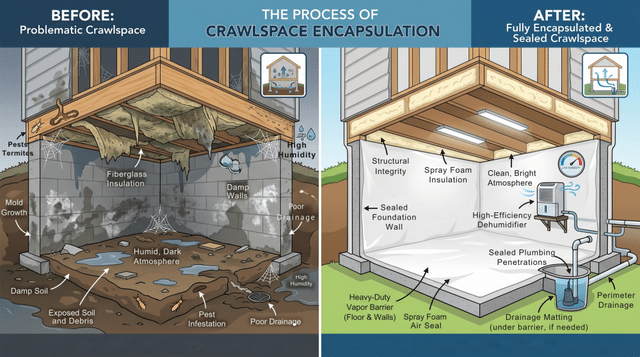
The goal is to create a cleaner, drier, and more controlled environment beneath the home.
How Does Crawlspace Encapsulation Reduce Radon?
Radon gas naturally forms in the soil beneath homes and can enter through:
-
Exposed earth
-
Foundation gaps
-
Crawl spaces
-
Utility penetrations
-
Structural openings
Why Crawl Spaces Matter
Many crawl spaces allow direct exposure between the home and the soil underneath. Without proper sealing, radon gas and moisture can move upward into living areas.
Encapsulation Can Help Limit Soil Gas Movement
By sealing exposed soil and reducing airflow from the crawl space, encapsulation may help:
-
Slow radon entry
-
Reduce moisture
-
Improve indoor air quality
-
Limit musty odors
-
Improve energy efficiency
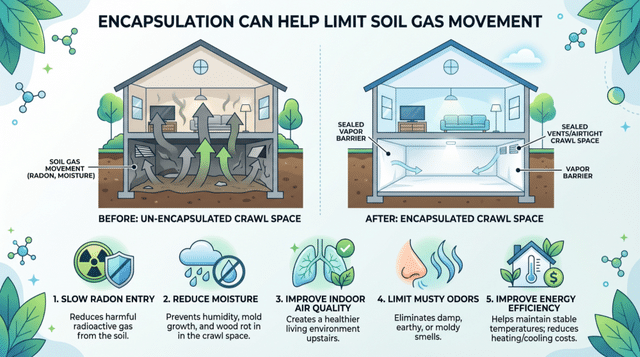
However, if radon levels are significantly elevated, encapsulation alone may not fully reduce radon to recommended levels.
Radon Mitigation May Still Be Needed
In many cases, crawlspace encapsulation works best when combined with:
-
Radon mitigation systems
-
Sub-membrane depressurization
-
Crawlspace vent piping
-
Continuous radon fans
This creates active control beneath the crawl space instead of relying only on passive sealing methods.
Is Crawlspace Encapsulation Necessary?
Not every crawl space requires full encapsulation, but many homes benefit from moisture and Air Quality Improvements below the structure.
Signs Encapsulation May Be Needed
Homeowners may consider encapsulation if they notice:
-
Musty odors
-
Damp crawl spaces
-
Visible moisture
-
Mold concerns
-
Cold floors
-
High humidity
-
Elevated radon levels
-
Wood deterioration
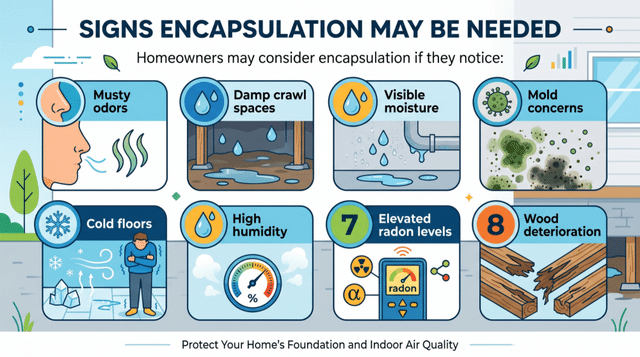
Because air naturally rises through a home, crawl space conditions can directly affect indoor air quality throughout upper living areas.
At Apex Radon Solutions, we often remind homeowners that what happens beneath the home doesn’t stay beneath the home.
How to Encapsulate a Crawlspace
One common homeowner question is how to encapsulate a crawlspace properly.
Typical Crawlspace Encapsulation Process
1. Remove Debris and Address Moisture Sources
The crawl space is cleaned and inspected for drainage or water intrusion issues.
2. Install a Vapor Barrier
A heavy-duty liner is placed across exposed soil and foundation surfaces.
3. Seal Openings and Gaps
Vents, seams, and penetrations are sealed to reduce outside air and moisture intrusion.
4. Add Dehumidification
A crawl space dehumidifier may be installed to maintain healthy humidity levels.
5. Integrate Radon Mitigation if Needed
Homes with elevated radon may require active mitigation beneath the encapsulation system.
Professional installation helps ensure the system performs effectively over the long term.
Crawlspace Vapor Barrier vs. Encapsulation
Many homeowners assume a crawlspace vapor barrier and full encapsulation are the same thing — but there are important differences.
Crawlspace Vapor Barrier
A vapor barrier usually refers to:
-
A plastic liner placed over exposed soil
-
Basic moisture reduction
-
Limited sealing coverage
While helpful, vapor barriers alone may not fully control:
-
Humidity
-
Air leakage
-
Mold conditions
-
Soil gases like radon
Full Crawlspace Encapsulation
Complete encapsulation typically includes:
-
Sealed walls and floors
-
Air sealing
-
Heavy-duty liners
-
Moisture control
-
Dehumidification
-
Integrated ventilation or radon mitigation systems
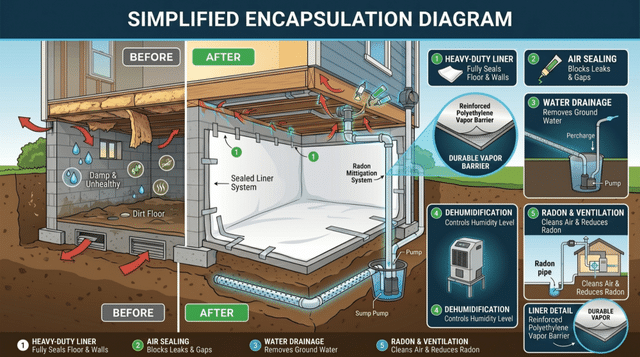
Encapsulation creates a much more controlled environment beneath the home.
Why Moisture and Radon Often Go Together
Homes with crawl space moisture issues may also experience:
-
Poor ventilation
-
Elevated humidity
-
Mold concerns
-
Air quality problems
-
Increased radon entry pathways
That’s why indoor air quality should be approached as a complete system.
At Apex Radon Solutions, we look at how:
-
Moisture
-
Ventilation
-
Radon
-
Airflow
-
Humidity
-
Filtration
all work together inside the home environment.
Trusted Crawlspace and Radon Solutions
At Apex Radon Solutions, we believe healthier indoor air starts beneath the home. Whether you’re dealing with crawl space moisture, elevated radon levels, or long-term indoor air quality concerns, our team is here to provide clear guidance and practical solutions designed for lasting protection.
From crawlspace encapsulation and dehumidification to professional radon mitigation services, Apex Radon Solutions helps homeowners create cleaner, safer, and healthier living environments with confidence and care.
Contact Apex Radon Solutions today to learn more about crawlspace encapsulation, moisture control, and indoor air quality solutions for your home.
