


Westport, CT's Dependable Radon Testing & Radon Mitigation Company
Experienced radon testing & radon mitigation contractor in Westport
Does your home or property have high radon levels? If levels are above 4 pCi/L (picocuries per liter), the Environmental Protection Agency (EPA) recommends installing a radon reduction system. As a tasteless, odorless, and invisible gas, radon can only be identified through testing. So if you're not sure about your property, Apex Radon Solutions is the trusted radon mitigation company that can help you answer this question!
Health facts about home radon:
- Radon is the #1 cause of lung cancer among non-smokers in the United States.
- More than 20,000 Americans die of radon-related lung cancer every year.
- Radon is a more significant health risk for children than adults.
- Breathing radon poses a greater health risk than ingesting water that contains radon.
- Smokers exposed to radon will substantially increase their likelihood of developing lung cancer.
While having any amount of radon in your home or building can be scary, there is no reason to worry. The modern radon mitigation systems from Apex Radon Solutions are highly effective in reducing home radon levels without causing much inconvenience.
At Apex Radon Solutions, we can help you choose the correct radon mitigation solution for your home and ensure that the installation process goes smoothly.
Indoor air quality services: air purifiers, dehumidifiers, air duct cleaning & more
While radon is scary all on its own, it isn't the only air pollutant that home and property owners should be aware of. Pollen, pet dander, mold spores, dust buildup, and contaminants trapped inside your HVAC system can cause just as many health issues. And the risk is even higher for those with asthma, respiratory issues, or allergies. That's why Apex Radon Solutions offers quality indoor air quality products and services, including professional air duct cleaning to help remove dust, debris, and allergens from your ductwork and improve airflow throughout your home.
- Radon testing
- Radon mitigation
- Multi-family radon mitigation
- Energy Recovery Ventilator
- Vapor Intrusion Mitigation
- Breathe EZ Air Cleaner
- Breathe EZ UV Light
- Dehumidifiers
- Air duct cleaning
Schedule radon testing or a free service estimate on any of our indoor air quality solutions. We serve Fairfield County, including Westport and nearby areas.
Schedule radon testing & a free radon mitigation estimate!
As a National Radon Defense dealer, Apex Radon Solutions has access to innovative radon testing and mitigation solutions, continuous training opportunities, and best practices from some of the best minds in the industry. So if you are worried about high radon levels or want to get rid of other airborne contaminants in your home or property, trust the qualified experts at Apex Radon Solutions!
Benefits of hiring a contractor in the National Radon Defense network:
- Licensed radon mitigation company
- Industry-leading radon mitigation systems
- Extensively trained & knowledgeable radon testing & mitigation specialists
- Free, no-obligation, in-home consultations
We offer radon testing and free estimates on our indoor air quality solutions. This includes radon mitigation, air purifier installation, dehumidifiers, air duct cleaning, energy recovery ventilators, and more! We proudly serve Connecticut homeowners in Westport and nearby.


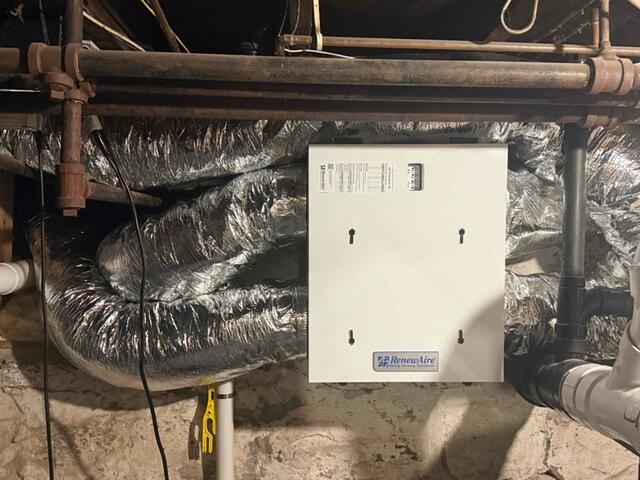
In Westport, we planned the installation of an Energy Recovery Ventilator (ERV) to improve air circulation and overall indoor air quality throughout the home's lower levels.
The system design includes a fresh air intake and exhaust connection serving the main foundation area, along with a dedicated exhaust branch designed to pull air from the crawl space. This approach helps promote balanced air exchange while reducing stagnant air conditions in both the basement and crawl space environments.
The installation will require approximately 150 feet of ductwork to properly connect the intake, exhaust, and crawl space ventilation pathways. Two exterior vent terminations will also be installed to allow the ERV to bring in fresh outdoor air while exhausting stale indoor air.
By continuously exchanging indoor and outdoor air, the ERV will help improve ventilation efficiency and support healthier indoor air conditions throughout the home.
A Continuous Radon Monitor (CRM) will be left on-site following installation to document post-installation conditions and verify system performance.
The project focused on improving whole-home ventilation, enhancing crawl space air movement, and creating healthier long-term indoor air quality conditions.
In Westport, we evaluated an existing radon mitigation system after additional testing showed elevated readings in multiple areas of the home.
Two separate radon tests were completed — one within the finished basement area, which measured approximately 7 pCi/L, and another within the unfinished section of the basement, which measured approximately 11.7 pCi/L.
The home currently operates with a two-point mitigation system, including one extraction point in the unfinished basement and another connected to an older encapsulated crawl space beneath the home.
Because the current mitigation fan is no longer functioning properly and elevated readings remain throughout multiple foundation sections, a broader system upgrade was recommended to improve long-term airflow performance beneath the structure.
The updated plan includes replacing the failed mitigation fan and adding a third extraction point within the finished basement foundation area. The new extraction point will require drilling through a concrete wall to improve sub-slab communication across the separate basement sections.
The encapsulated crawl space will also be inspected during the visit to verify that the vapor barrier remains securely attached and continues providing proper airflow control beneath the crawl space area. If deterioration or separation is identified, additional repair or replacement recommendations may be provided.
The project focused on restoring reliable system operation, expanding airflow coverage beneath all foundation sections, and evaluating the condition of the older crawl space encapsulation system to improve long-term indoor air quality throughout the home.
In Westport, we worked on a home built in the mid-1960s where radon levels tested at 3.8 and 4.3 pCi/L in different areas of the property. The homeowner wanted levels reduced even further, with a goal of bringing readings below 2.7 pCi/L.
The home includes several unique foundation areas, including a crawl space and a separate wine cellar room located behind the boiler area. The property also has three sealed sump pumps installed by Connecticut Basement Systems, along with existing drainage components designed to manage groundwater.
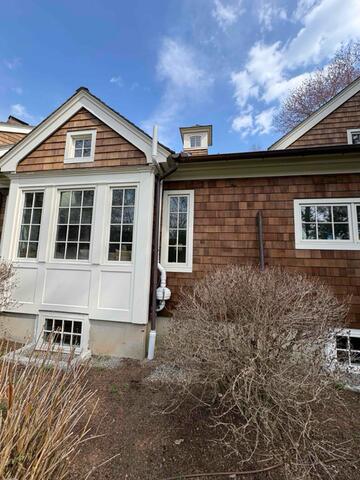
To improve overall coverage, a three-pipe radon mitigation system was installed. One extraction point was placed in the main foundation, another in the crawl space, and additional piping was routed through the wine cellar area to address the smaller isolated space behind the boiler.
The crawl space piping was routed through the sill plate to maintain a clean layout while improving airflow beneath the home.
This system was designed to work alongside the existing waterproofing setup while providing more balanced radon reduction across all areas of the foundation.
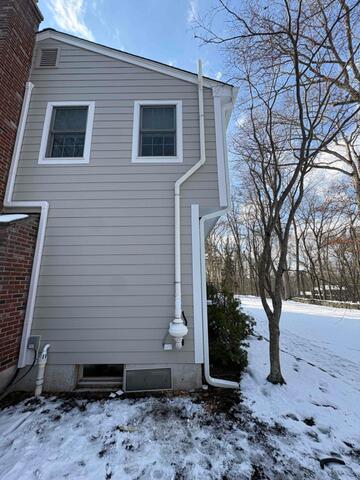
For this Westport job, the homeowner has been proactive in requesting that the radon mitigation system integrate cleanly with their mostly finished basement. With a radon reading of 4.5 pCi/L, a single-pipe system is recommended.
The house, constructed in 1980, has one cement foundation, no crawl spaces, no sump pump, and no water guard system. The client directed that the system be placed within the mechanical room, which offers a direct pathway to the rear of the house. From there, they specifically requested that the radon exhaust pipe exit through the second bay on the right-hand side of the basement, a spot they identified as both discreet and optimal for venting.
The installation team will ensure the pipe is neatly routed from the suction point to the designated exterior location, taking care to preserve the integrity of the finished areas. This job is a perfect example of a collaborative approach where the client’s preferences were clearly communicated and factored into a custom, low-profile solution.
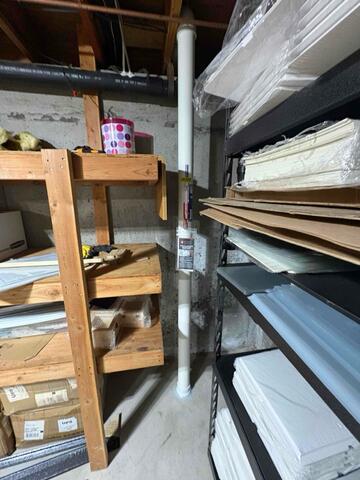
This Westport property features a complex basement with four separate foundation sections, necessitating a four-pipe radon mitigation system for full coverage.
The project is being done in collaboration with David, the builder, who is taking a hands-on approach. David is installing the entire vertical pipe infrastructure: running Schedule 40 pipes from each foundation section, through a centrally located chase, and up through the cedar shake roof.
It was made explicitly clear to the builder that our team will not penetrate or modify the cedar roof in any way. All roofing tasks, including flashing and sealing, fall under the builder’s responsibility. David has also agreed to handle all drywall repairs post-installation.
Our role includes:
-
Completing all basement-level connections for the four-pipe system.
-
Installing the radon fan in the attic, with the expectation that electrical access is available at the fan location.
-
Verifying system integrity and testing after setup is complete.
This partnership allows for a streamlined, high-efficiency system while minimizing aesthetic and structural disruption to the home. Builder coordination ensures proper timing and logistics before our team arrives on-site for final install and activation.

This Westport job was coordinated entirely remotely with the seller, who will not be present during the fan replacement. The request came as part of a real estate transaction, where the buyers or inspectors likely noted that the radon system was inactive. The radon fan is no longer operational and needs to be replaced before the sale can proceed.
Although there was no preliminary site visit, the seller left the Bilco door unlocked to allow interior access. The technician is expected to identify the location of the system and replace the defective fan with a new unit—matching the type and size as closely as possible unless a universal upgrade is necessary.
Since the home may be vacant or in staging, care should be taken to avoid any disruption and ensure that the new system is sealed, wired, and operational per state standards. This installation does not require re-routing piping or adding new extraction points—just a professional, efficient fan swap to restore the system's functionality before closing.
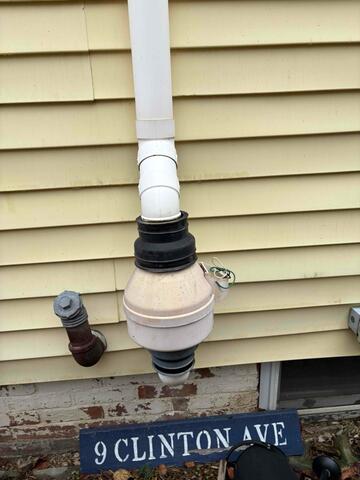
In Westport, we were called in to assess a 20-year-old radon mitigation fan that had grown loud enough to disrupt daily life. Our team quickly diagnosed the issue and replaced the outdated unit with a new, energy-efficient model, restoring proper airflow and eliminating noise. No additional system modifications were required — just a straightforward swap that brought immediate results. The client now enjoys a silent, fully functioning system that meets modern standards.
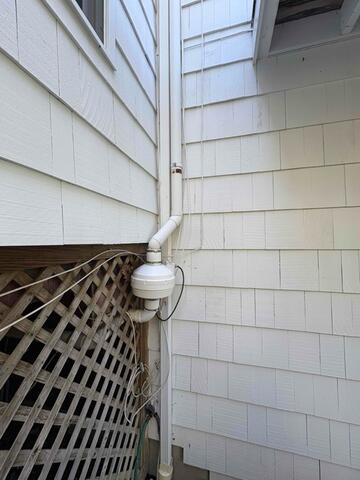
In this Westport, CT home, we faced a dirt crawl space with damaged CleanSpace and drainage matting. The radon levels measured 5.3 pCi/L, requiring a reliable two-pipe system.
What made this job unique: there was no existing electrical access in the crawl space. Instead of requiring the homeowner to hire an electrician, our team built an external outlet and completed the electrical connection for the radon fan.
We entered the crawl space carefully, using full coveralls and knee protection to protect the matting. The system now exits the right side of the house, fully functional and ready to keep the air safe.
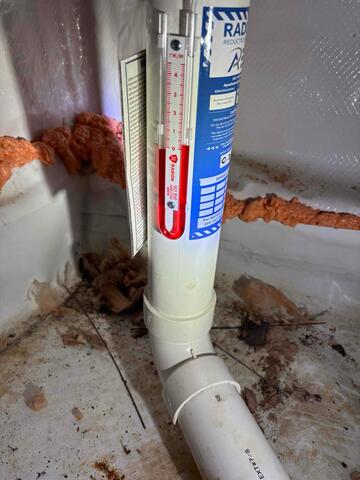
With a radon level of 3.5 pCi/L, this homeowner in Westport took proactive steps to secure their basement environment. The home, built in 1964, had an unfinished basement, two sump pumps (one already sealed), and was an ideal candidate for a two-pipe mitigation system.
We advised the homeowner to move items around the intended install zone and placed one of the pipes between two A/C units on the left exterior side of the house — an efficient and discreet placement for long-term safety.
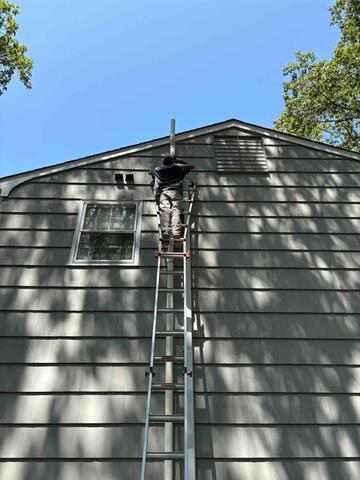
In Westport, CT, a homeowner was dissatisfied with the noise from an existing radon mitigation fan in their 2002-built, 120,000 sq ft mansion. With an average radon level of 2.2, they aimed not only to reduce the noise but also to explore options for healthier air. Our solution involved installing a new, quieter fan and deploying three radon CRMs to ensure continuous monitoring and adjustment. Positioned in the mansion’s basketball court, gym, and wine cellar, these measures were designed to maintain optimal air quality across diverse living spaces.

In 2002, a grand Westport home spanning 120,000 sq ft faced issues with a noisy radon mitigation fan and an average radon level of 2.2. The homeowner desired a quieter and more efficient system to ensure optimal indoor air quality. Our tailored approach included replacing the noisy fan and deploying three radon Continuous Radon Monitors (CRMs) in key locations: the home's basketball court, gym, and wine cellar. This precision-targeted installation underscores our commitment to providing bespoke solutions that cater to the unique needs and amenities of luxury properties.
