Back-to-School Radon Safety: Is Your Child's School Safe?
Back to School Is About More Than New Supplies
A new school year brings a familiar checklist for parents.
New backpacks.
New shoes.
New notebooks.
New teachers.
New routines.
But there is one back-to-school question that rarely makes the list:
Has your child's school been tested for radon?
When we think about protecting our children at school, we naturally think about the things we can see. Clean classrooms. Safe playgrounds. Healthy lunches. Secure entrances. Good hygiene.
Radon is different.
It is invisible, odorless, and tasteless. You cannot look around a classroom and know whether radon is present. You cannot smell it when you walk through the school doors. And a classroom can look completely clean and well maintained while still having elevated radon levels.
That is why back-to-school season is an important time to think about indoor air quality — including radon.
The U.S. Environmental Protection Agency recommends that schools test for radon, particularly in frequently occupied rooms at or below ground level. EPA also identifies 4.0 pCi/L as the action level at which schools should take steps to reduce radon.
The good news is that radon is something we can test for, understand, and address.
At Apex Radon Solutions, we believe parents, teachers, administrators, and school districts should have access to clear information about the air children and staff breathe every day.
What Is Radon?
Radon is a naturally occurring radioactive gas produced by the breakdown of uranium in soil and rock.
Because it comes from the ground, radon can enter buildings through openings that connect indoor spaces with the soil beneath or around the structure.
These pathways can include:
-
Cracks in floors and foundations
-
Construction joints
-
Gaps around pipes and utility lines
-
Floor drains
-
Sump areas
-
Gaps in suspended floors
-
Hollow masonry walls
-
Other openings in areas that contact the ground
Once inside, radon can accumulate, particularly in lower areas of a building.
Radon does not announce itself. It does not have a smell or color that alerts someone to its presence.
Testing is the only way to know whether elevated radon is present.
This is what makes radon different from many of the other hazards parents think about when preparing their children for a new school year.
Why Radon Belongs on the Back-to-School Checklist
Back-to-school season is a natural time to revisit school safety.
Students are returning to classrooms. Teachers are preparing their rooms. HVAC systems are being used regularly again. Families are settling back into daily routines.
That makes it a good opportunity to ask questions about the school environment — including indoor air quality.
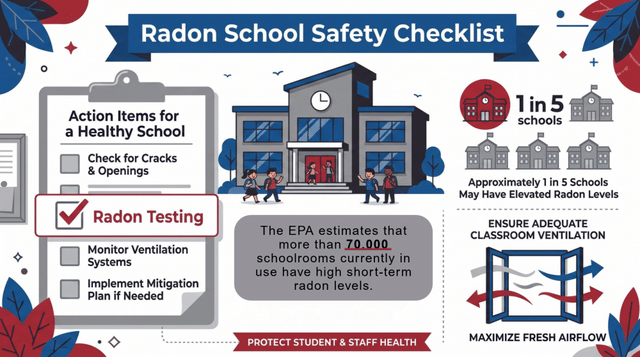
The EPA estimates that nearly one in five schools nationwide has at least one schoolroom with a short-term radon level above 4 pCi/L. The EPA also estimates that more than 70,000 schoolrooms currently in use have high short-term radon levels.
That does not mean every school has a radon problem.
It means we cannot know which schools or classrooms have elevated radon without testing.
And that distinction matters.
The goal is not to scare parents or create unnecessary alarm. The goal is to replace uncertainty with information.
Children Spend a Significant Part of Their Day at School
For many families, school is where children spend a large portion of their weekday.
That means the quality of the indoor environment matters.
Students may spend hours each day in:
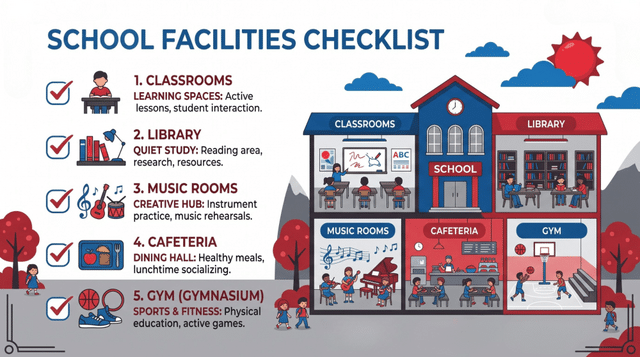
Teachers and school employees spend their working days in these same environments.
The EPA recommends testing frequently occupied rooms at or below ground level because these spaces may have greater potential for elevated radon.
This is especially relevant for classrooms or other spaces that are in direct contact with the ground.
The Hidden Risk in Schools
Radon enters schools in much the same way it enters homes.
The building may have a concrete slab, a basement, a crawl space, or another ground-contact area beneath it. If radon is present in the soil, the gas can move through openings in the structure.
Older Buildings Aren't the Only Concern
It is easy to assume that radon is primarily an issue in older school buildings.
That is not necessarily the case.
The EPA notes that any building can have elevated radon, including new and old structures, well-sealed and drafty buildings, and buildings with or without basements.
That means the age of the school building does not tell you whether radon is present.
Testing does.
HVAC Systems Matter, Too
HVAC systems are an important part of school indoor air quality, but ventilation should not be treated as a substitute for identifying and controlling a radon source.
Building pressure can influence how radon moves from the soil into a structure. The EPA explains that differences between indoor and soil pressure can cause buildings to draw radon indoors through foundation openings.
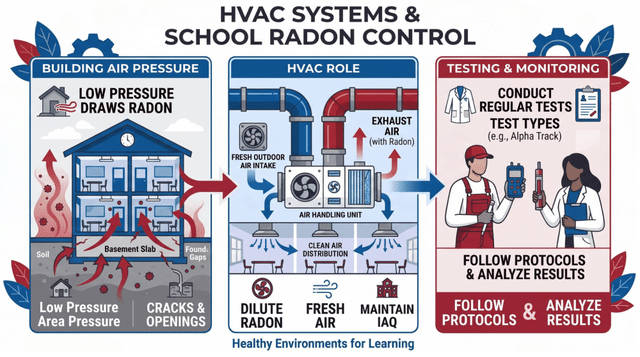
That is one reason radon should be considered as part of a school's broader indoor air quality program.
Is Your Child's School Safe From Radon?
This is the question parents should be asking.
Not:
"Does the school look clean?"
Not:
"Is the building new?"
Not:
"Does the school have a good HVAC system?"
Instead:
"Has the school been tested for radon, and what were the results?"
A school can have excellent teachers, a dedicated maintenance team, and a well-maintained building and still have elevated radon.
Radon testing provides information that visual inspections cannot.
Connecticut Schools Have Specific Radon Testing Requirements
For Connecticut parents, this question becomes even more relevant.
The Connecticut Department of Public Health states that public schools serving grades K–12 are required to test for radon in air under Connecticut General Statutes. School administrators are also expected to keep radon test reports on file and notify students, teachers, and parents about radon test information.
Connecticut's Three-Year Radon Re-Evaluation
Connecticut DPH currently states that radon re-evaluations in public schools are conducted every three years.
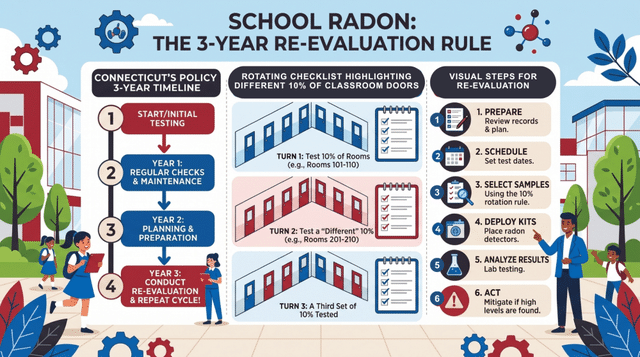
This is important because the testing schedule is not simply a one-time event.
A school that tested years ago should not assume that old results automatically describe current conditions.
Building conditions change.
Spaces change.
HVAC systems change.
Renovations happen.
And radon levels can change.
What About Schools That Already Have Radon Mitigation?
Testing does not necessarily end when a mitigation system is installed.
Connecticut DPH's school guidance provides a separate re-evaluation schedule for rooms with radon mitigation systems. Mitigated rooms require re-evaluation every two years to help ensure the system continues working to reduce radon levels.
This is an important point for school administrators and facility managers:
A Radon Mitigation System is not a "set it and forget it" solution.
The system needs to continue operating properly, and follow-up testing helps verify performance.
What Should Parents Ask the School?
Back-to-school is the perfect time to ask a few straightforward questions.
You do not need to be a radon expert.
Start with these:
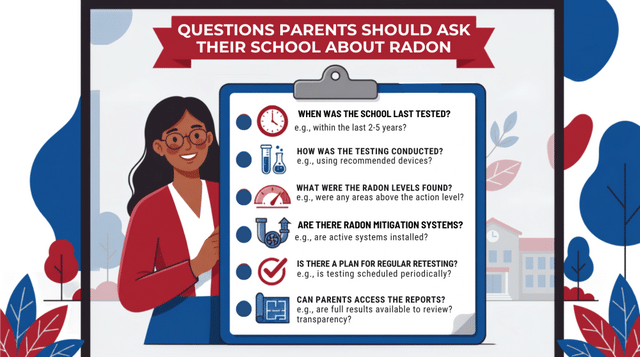
These are reasonable questions.
They are not accusations.
They are part of being an informed parent.
What Happens If a School Has Elevated Radon?
The discovery of elevated radon does not mean a school has to close its doors or that the building cannot be made safer.
The EPA notes that radon problems in schools can be corrected using established mitigation techniques.
Radon Mitigation in Schools
A professional radon mitigation system may use techniques such as:
-
Sub-slab depressurization
-
Sub-membrane depressurization
-
Specialized vent piping
-
Radon fans
-
Sealing and soil-gas control measures
-
Other building-specific approaches
The correct system depends on how the building is constructed and where radon is entering.
Commercial and school buildings can be significantly more complex than residential homes. A school may have multiple wings, different foundation types, additions, mechanical rooms, crawl spaces, or other areas that need to be evaluated.
That is why professional assessment matters.
What Parents Can Do Today
You don't have to wait for a problem to become obvious.
Start with one question:
"When was the last radon test conducted at my child's school?"
If you don't know, ask the school administration.
If the school has recent results, ask what they showed.
If elevated levels were found, ask what steps were taken.
And if you are a school administrator or facilities professional, make sure your radon testing and re-evaluation schedule is current.
The goal isn't fear.
The goal is awareness.
What Apex Radon Solutions Can Do for Schools
At Apex Radon Solutions, our work isn't limited to residential homes.
We believe schools, daycares, and learning environments deserve the same attention to indoor air quality that we give to the places where families live.
Our school-focused services can include:
Professional Radon Testing
Testing helps identify whether elevated radon is present in frequently occupied areas of a school.
Radon Mitigation
When elevated levels are identified, properly designed mitigation systems can help reduce radon concentrations.
Documentation
School radon projects require appropriate documentation and reporting. Apex can help administrators understand the testing and mitigation process and the information that needs to be maintained.
Ongoing Support
A mitigation system needs to remain functional. Follow-up testing and system monitoring are important parts of long-term radon management.
School and District Outreach
If you're a parent, teacher, administrator, or community member interested in starting a conversation about radon testing, we can provide educational information and discuss appropriate next steps.
No pressure.
No scare tactics.
Just science, testing, and practica
