ERV or HRV: Which Ventilation System Is Better for Radon Reduction?
ERV vs HRV for Radon Mitigation
When homeowners begin exploring ways to improve indoor air quality and reduce radon levels, they often encounter two ventilation options: Energy Recovery Ventilators (ERVs) and Heat Recovery Ventilators (HRVs).
This naturally leads to an important question: which is better for radon mitigation—an ERV or an HRV?
The answer depends on your home's construction, climate, humidity levels, and overall indoor air quality goals. While both systems can improve ventilation and help dilute indoor contaminants, neither should be viewed as a replacement for a properly designed radon mitigation system when elevated radon levels are present.
In this guide, we'll explain the differences between ERV radon mitigation and HRV radon mitigation, when each system may be beneficial, and how they fit into a complete indoor air quality strategy.
Understanding Ventilation and Radon
Radon is a naturally occurring radioactive gas that enters homes from the soil beneath foundations.
It commonly enters through:
-
Foundation cracks
-
Crawl spaces
-
Sump pits
-
Utility penetrations
-
Construction joints
Because radon accumulates indoors, increasing ventilation can sometimes help lower concentrations by introducing fresh outdoor air and exhausting stale indoor air.
However, ventilation alone is often not enough to solve elevated radon problems, especially when radon levels exceed recommended action levels.
What Is an HRV?
A Heat Recovery Ventilator (HRV) is a mechanical ventilation system that exchanges stale indoor air with fresh outdoor air while recovering heat from the outgoing air.
How HRVs Work
An HRV:
-
Removes stale indoor air
-
Brings in fresh outdoor air
-
Transfers heat between air streams
-
Helps improve energy efficiency
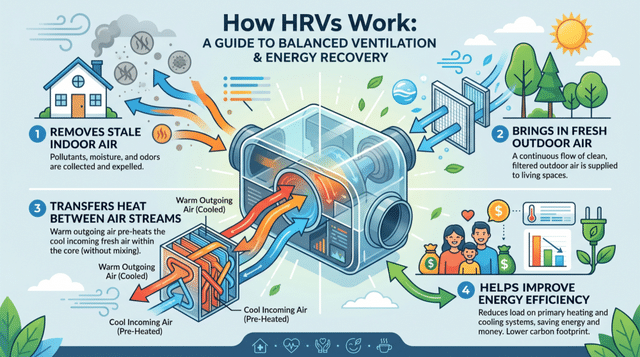
This process helps maintain indoor comfort while improving ventilation.
HRV Radon Mitigation Benefits
An HRV may:
-
Increase fresh air circulation
-
Reduce indoor air pollutants
-
Help dilute radon concentrations
-
Improve overall indoor air quality
HRVs are often recommended in colder climates where homes remain tightly sealed during winter months.
What Is an ERV?
An Energy Recovery Ventilator (ERV) works similarly to an HRV but also transfers moisture between the incoming and outgoing air streams.
How ERVs Work
An ERV:
-
Exchanges indoor and outdoor air
-
Transfers heat
-
Transfers moisture
-
Helps manage humidity levels
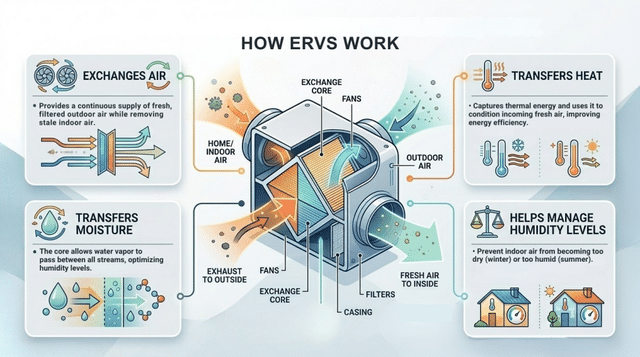
This added humidity control can make ERVs attractive in climates where moisture management is a concern.
ERV Radon Mitigation Benefits
An ERV may help:
-
Improve ventilation
-
Support humidity control
-
Reduce indoor contaminants
-
Improve comfort throughout the home
While ERVs can assist with indoor air quality, their primary advantage over HRVs is moisture management rather than radon reduction.
ERV vs HRV for Radon Mitigation
Similarities
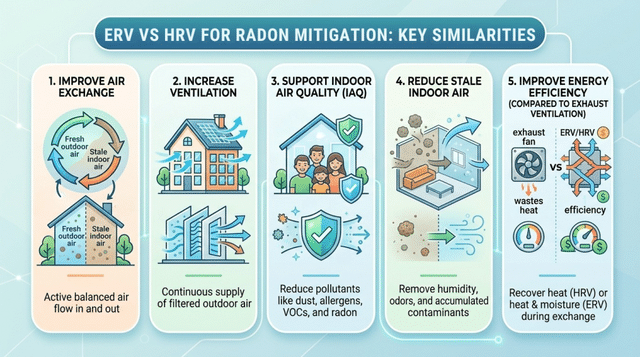
Both systems:
-
Improve air exchange
-
Increase ventilation
-
Support indoor air quality
-
Reduce stale indoor air
-
Improve energy efficiency compared to simple exhaust ventilation
Key Differences
HRV Systems
Best suited for:
-
Colder climates
-
Homes with dry indoor air
-
Ventilation-focused applications
Primary benefit:
-
Heat recovery
ERV Systems
Best suited for:
-
Humid climates
-
Homes with moisture concerns
-
Indoor humidity management
Primary benefit:
-
Heat and moisture recovery
Which Is Better for Radon Reduction?
When comparing ERV radon mitigation and HRV radon mitigation, many radon professionals lean toward HRVs when ventilation is being considered specifically for radon reduction.
Why HRVs Are Often Preferred
HRVs:
-
Maximize fresh air exchange
-
Focus on ventilation effectiveness
-
Are commonly used in northern climates
-
May provide greater dilution of indoor contaminants
However, the actual impact on radon levels depends on:
-
Home design
-
Airflow patterns
-
Existing radon concentrations
-
Foundation conditions
Every home responds differently.
Can ERVs or HRVs Replace Radon Mitigation?
This is one of the most important questions homeowners ask.
The Short Answer: Usually No
While ERVs and HRVs may help reduce radon concentrations in some situations, they are generally not considered primary radon mitigation systems.
Professional Radon Mitigation Systems are specifically designed to:
-
Prevent radon entry
-
Create sub-slab depressurization
-
Redirect soil gases outdoors
-
Continuously reduce radon levels
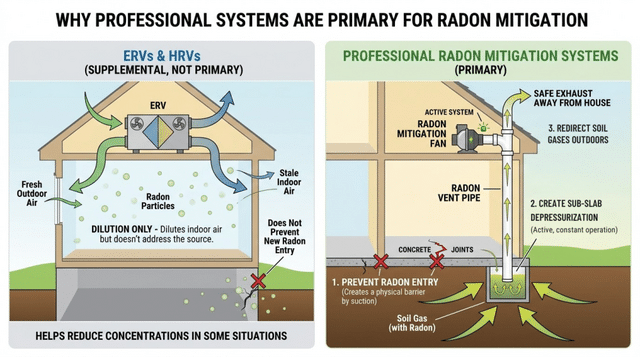
Ventilation systems primarily address indoor air exchange rather than the source of the radon itself.
For homes with elevated radon levels, ventilation may complement mitigation but rarely replaces it.
The Bigger Picture: Indoor Air Quality
At Apex Radon Solutions, we view indoor air quality as a complete system.
Radon, humidity, ventilation, airflow, and moisture all influence the comfort and health of a home.
In many situations, homeowners benefit from combining:
-
Radon mitigation
-
Crawl space improvements
-
Dehumidification
-
Ventilation upgrades
-
Air filtration
The goal is not simply lower radon levels—it’s creating a healthier indoor environment overall.
When Should You Consider an ERV or HRV?
Homeowners may benefit from an ERV or HRV if they experience:
-
Stale indoor air
-
Poor ventilation
-
Excess humidity
-
Dry winter air
-
Energy-efficiency concerns
-
Indoor air quality complaints
A professional evaluation can help determine whether ventilation improvements should be part of a broader indoor air quality strategy.
Trusted Radon Mitigation and Indoor Air Quality Solutions
At Apex Radon Solutions, we help homeowners understand how ventilation, humidity control, and radon mitigation work together to create healthier homes. Whether you're evaluating an ERV, considering an HRV, or looking for a proven radon mitigation solution, our team is here to provide clear answers and practical recommendations.
If you're concerned about indoor air quality or elevated radon levels, contact Apex Radon Solutions today. We'll help you determine the best solution for your home's unique needs and create a healthier environment for your family.
