Understanding Radon in Commercial Buildings and How to Reduce It
Radon Mitigation in Commercial Buildings
When most people hear about radon, they often think of residential homes. However, radon is not limited to houses. Offices, schools, healthcare facilities, warehouses, apartment complexes, and other commercial properties can also experience elevated radon levels.
Because commercial buildings often accommodate large numbers of employees, tenants, customers, or students, understanding radon in commercial buildings is an important part of maintaining a healthy indoor environment.
In this guide, we'll explain how radon affects commercial properties, why testing matters, and how radon mitigation in commercial buildings helps reduce long-term exposure risks.
What Is Radon?
Radon is a naturally occurring radioactive gas formed by the breakdown of uranium in soil and rock beneath the earth's surface.
The gas can enter buildings through:
-
Foundation cracks
-
Expansion joints
-
Utility penetrations
-
Floor drains
-
Crawl spaces
-
Sump pits
-
Structural openings
Because radon:
-
Has no smell
-
Has no color
-
Has no taste
testing is the only reliable way to determine whether elevated levels are present.
According to the United States Environmental Protection Agency, radon exposure remains one of the leading causes of lung cancer among non-smokers.
Can Commercial Buildings Have Radon?
Absolutely.
Many property owners assume radon is only a residential concern, but commercial structures can experience the same soil gas intrusion issues as homes.
Types of Commercial Buildings That May Be Affected
Radon has been detected in:
-
Office buildings
-
Medical facilities
-
Schools
-
Universities
-
Government buildings
-
Retail centers
-
Apartment complexes
-
Manufacturing facilities
-
Warehouses
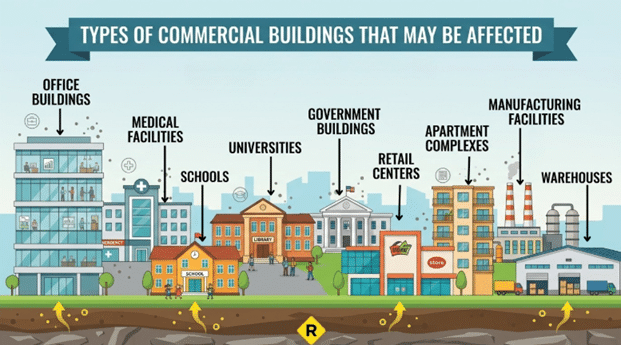
Any building that sits on or near the ground can potentially experience elevated radon levels.
Why Radon in Commercial Buildings Matters
Commercial properties often have larger footprints and accommodate more occupants than residential homes.
Potential Concerns Include
-
Employee exposure
-
Tenant health concerns
-
Indoor air quality compliance
-
Property management responsibilities
-
Workplace safety initiatives
While radon risk is generally associated with long-term exposure, proactive testing helps building owners understand whether mitigation may be necessary.
How Radon Enters Commercial Buildings
The same forces that affect homes also affect commercial structures.
Common Entry Points
Radon may enter through:
-
Cracks in concrete slabs
-
Utility penetrations
-
Elevator shafts
-
Floor drains
-
Construction joints
-
Mechanical rooms
-
Expansion joints
Large commercial buildings often have multiple pathways that allow soil gases to enter.
Building Pressure Can Increase Entry
HVAC systems, exhaust fans, and building pressure differences can sometimes draw radon into the structure.
This makes proper testing and diagnosis especially important.
Commercial Radon Testing
Before mitigation can be considered, the building must be properly evaluated.
Why Commercial Testing Is Different
Commercial testing often requires:
-
Multiple monitoring locations
-
Occupancy evaluations
-
HVAC assessments
-
Long-term data collection
-
Building-specific testing plans
Unlike residential testing, commercial projects may involve dozens or even hundreds of test locations depending on the building size.
Continuous Radon Monitoring
Professional continuous radon monitors are frequently used because they provide:
-
Hourly measurements
-
Detailed reporting
-
Trend analysis
-
Reliable documentation
This helps property owners make informed decisions based on accurate data.
How Radon Mitigation in Commercial Buildings Works
Commercial mitigation systems are often more complex than residential systems because of building size and design.
Common Commercial Mitigation Methods
Sub-Slab Depressurization
This is one of the most common mitigation techniques.
The system creates negative pressure beneath the building slab to prevent radon from entering occupied spaces.
Sub-Membrane Depressurization
Used in buildings with crawl spaces, this method places suction beneath a sealed membrane to collect soil gases before they enter the structure.
Ventilation Improvements
In some situations, mechanical ventilation systems may be modified to improve air exchange and support overall indoor air quality.
Building Pressure Adjustments
HVAC systems may be adjusted to help reduce radon entry through pressure management strategies.
Challenges of Commercial Radon Mitigation
Every commercial property presents unique challenges.
Factors influencing system design include:
-
Building size
-
Occupancy patterns
-
Foundation type
-
HVAC configuration
-
Accessibility
-
Structural design
A successful mitigation plan requires a thorough understanding of how the building operates as a complete system.
The Connection Between Radon and Indoor Air Quality
At Apex Radon Solutions, we believe radon should be considered part of a broader indoor air quality strategy.
Commercial properties may also face:
-
Ventilation concerns
-
Humidity issues
-
Airflow imbalances
-
Mold conditions
-
Occupant comfort complaints
Addressing radon alongside these factors helps create healthier indoor environments for employees, tenants, and visitors.
When Should Commercial Buildings Be Tested?
Property owners should consider radon testing when:
-
Purchasing a commercial property
-
Renovating lower-level spaces
-
Addressing indoor air quality concerns
-
Managing schools or healthcare facilities
-
Evaluating tenant safety programs
-
Conducting environmental assessments
Testing provides valuable information that can guide future building decisions.
Trusted Commercial Radon Mitigation Services
At Apex Radon Solutions, we understand that commercial properties require practical, reliable, and professionally designed radon solutions. Whether you manage an office building, healthcare facility, school, apartment complex, or industrial property, our team provides the expertise needed to evaluate indoor air quality and develop effective mitigation strategies.
From commercial radon testing and continuous monitoring to customized mitigation system design, Apex Radon Solutions helps property owners protect occupants while maintaining confidence in their indoor environment.
If you're concerned about radon in commercial buildings or would like to schedule professional testing, contact Apex Radon Solutions today to learn more about our commercial radon mitigation services.
